
Skip to content

Sustainability pays

How life cycle assessment finds the cost and risk hiding in your supply chain, and shows which fixes are worth paying for while design decisions are still open.

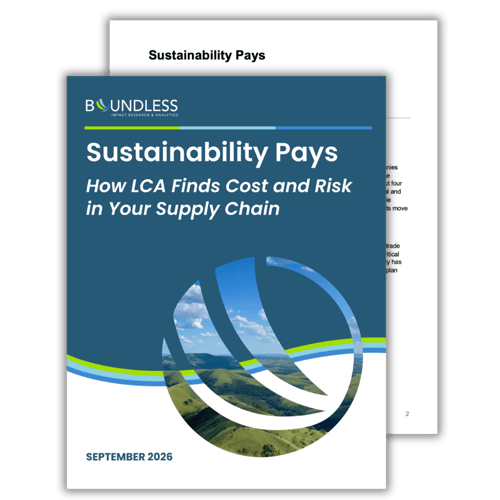
Boundless Sustainability Pays - Cover

Download the White Paper

Why read it

Cost and footprint move together. Most teams track them apart.

Supply chain disruption now costs businesses an estimated $184 billion a year, and around 75% to 80% of a product's cost is locked in during design. The decision window is short, and comparing suppliers on price and footprint at the same time usually means reconciling numbers kept by different teams in different units.

This white paper shows how a Life Cycle Assessment, built the right way, becomes a live decision tool rather than a reporting exercise. Using a plastic recycler as a running example, it covers:

  • What an LCA measures from cradle to grave, and the two terms that make one defensible

  • How integrated LCAs put cost and footprint in one model, and dynamic LCAs keep it current

  • How to find hot spots, the life cycle stages carrying a disproportionate share of cost and footprint

  • Why sector averages miss what supplier-specific data reveals

  • How to price a fix with capital cost, operating cost, and revenue to get a payback period

  • When to update the model, using materiality thresholds instead of a new four-to-twelve month study

What a hot spot is actually worth

Same bale price. Two very different costs.

A worked example from inside the paper: a plastic recycler pays $500 a tonne for baled plastic. What it really pays per tonne of saleable pellet depends on how much of each bale makes it through the process.

Single-stream bales

Usable yield 68%

$735

per tonne of saleable pellet. The other 32% is still collected, trucked, sorted, washed, and dried.

Bottle-return bales

Usable yield 85%

$588

per tonne of saleable pellet, from the same $500 bale price.

$147 per tonne of output before any premium for cleaner input. Multiply by annual tonnage and you have a payback period.

Illustrative example based on published yield estimates from the Container Recycling Institute. Actual yields and costs vary by supplier, region, and process. Lower yield raises footprint per tonne as well as cost, since both are calculated per tonne sold.

Sustainability pays White paper

Boundless Sustainability Pays - Cover

Download the White Paper

Note from our founder

Why We Built LifeCycle IQ
I started LifeCycle IQ because I kept watching good companies get stuck between two bad options.

A quick carbon calculator could give them a number in an afternoon, but it fell apart the moment a customer, an investor, or a regulator asked how it was built. A full ISO-compliant study held up under scrutiny, but it cost fifty to a hundred thousand dollars and took months, often long after the material or supplier decision it was meant to inform had already been made.

Neither option matched how these decisions actually get made. Product and supply chain choices happen continuously, across dozens of materials and suppliers, usually with a cost number from one team and a sustainability number from another. Nobody had built a tool that kept up with that pace while still holding up to real scrutiny.

That is what LifeCycle IQ is. It is not a report you commission once and file away. It is a model built to ISO 14040 and 14044 standards that stays live as your suppliers and materials change, with cost data and sustainability data in the same place, because in our experience they were never really separate numbers to begin with.

We built it for the people who have to make the material or supplier call and then defend it, on both cost and sustainability grounds, often before all the data is perfect. That defensibility, delivered fast enough to actually inform the decision, is the whole point.

If that is the position you are in, I would like to hear about it.

Michele Demers Signature 2-1 Founder & CEO

About LifeCycle IQ

Life Cycle Assessment, Reimagined as a Decision Tool

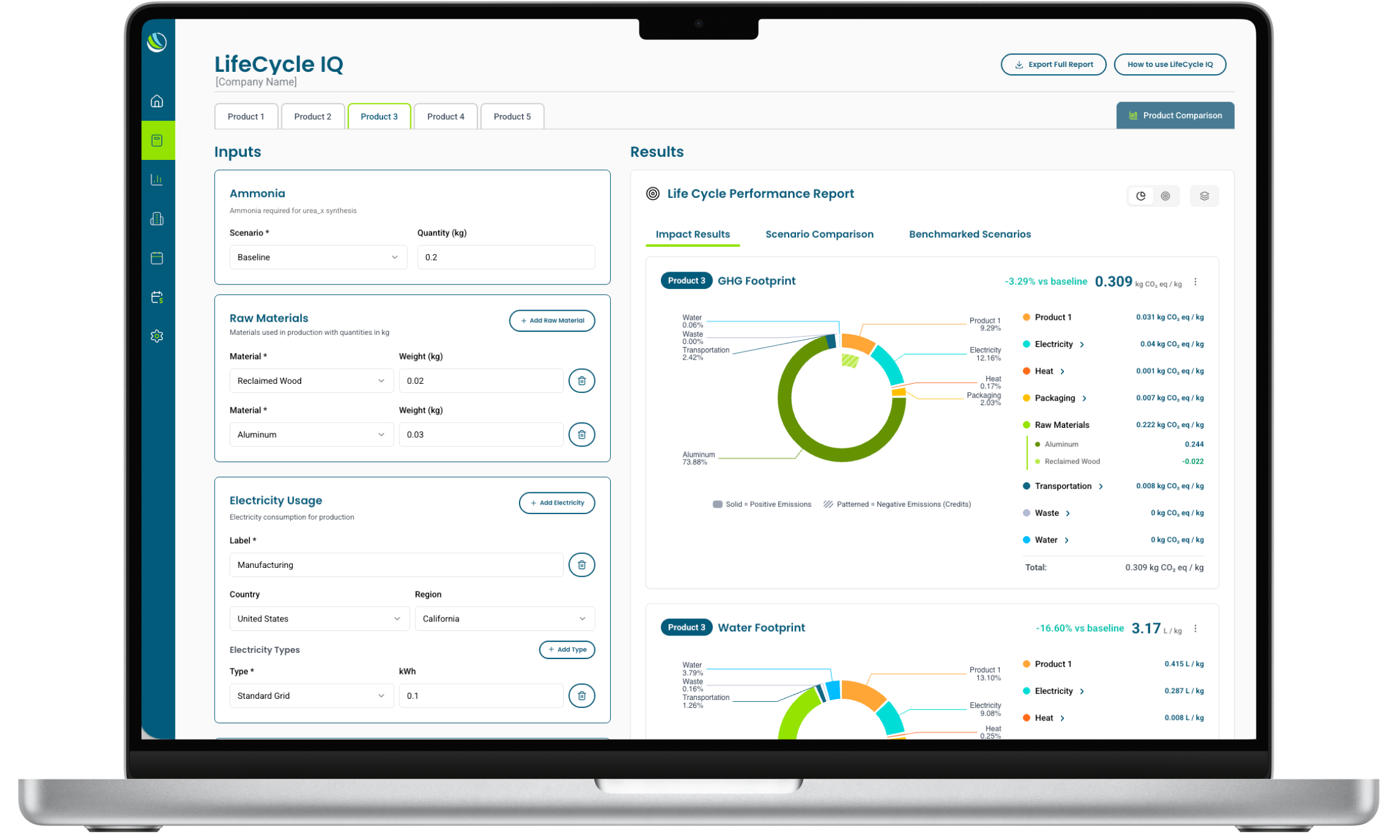
Most LCAs are built to satisfy a request, then sit in a folder. LifeCycle IQ is built to be used. It puts product-level LCA and cost analysis in one model, so you can swap a supplier, change a material, or shift volume and see what happens to footprint, cost, and risk before you commit. Every model follows ISO 14040 and 14044, is reviewed by independent researchers, and is benchmarked against our database of more than 450 industries, so your results hold up when a customer, investor, or regulator asks how they were built. And because the model updates as your product changes, it's still right next quarter.
Book a meeting

LifeCycle IQ dashboard showing multi-product inputs, GHG and water footprint results, and benchmarked scenarios

About Boundless

An Industry Research and Impact Analytics Firm, Since 2013

Boundless is an industry research and environmental impact analytics firm that provides objective, actionable insights to accelerate investment toward clean technologies and companies driving positive environmental change. We employ a science-based, data-driven approach grounded in the proven methodologies of LCA and Techno-Economic Analysis.

Our approach emphasizes close collaboration with customers, so models and analyses stay representative of their specific systems, products, and operational realities. The scores and metrics we produce are robust and decision-relevant, supported by independent validation from external industry and scientific experts.