
Skip to content

New white paper · October 2026

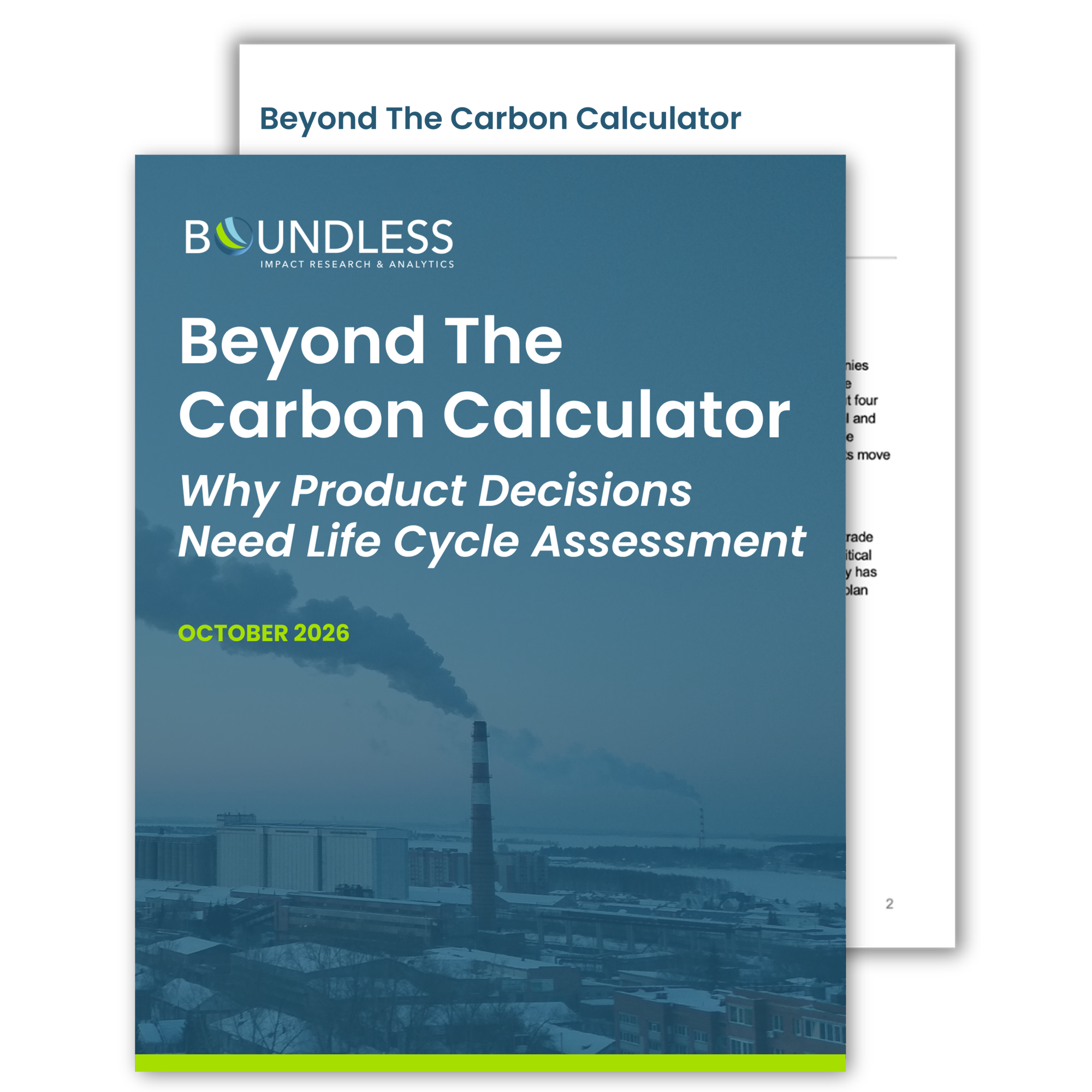
Beyond the Carbon Calculator

Why product decisions need Life Cycle Assessment.

Carbon calculators were built to estimate a company’s emissions. Regulators, buyers, and investors now want something else: proof that a specific product is better. This paper explains where carbon calculators fall short, what Life Cycle Assessment measures that they miss, and how to choose the right tool.

  • What the EU’s September 27, 2026 claims rules mean for product marketing
  • Why spend-based data can make a greener purchase look worse
  • Two Boundless case studies with real, multi-metric LCA results

Get the White Paper

Free. We’ll email you a copy.

Why now

The Questions Changed. The Proof Has to Change With Them.

EU claims rules

Sept 27, 2026

The EU law now bans vague green claims without proof.1

Investors

44%

of investors say sustainability reporting contains unsupported claims to a large or very large extent.2

Verified EPDs

20,000+

published through the International EPD System, double its 2024 total.3

Spend-based data

Up to 60%

over- or underestimation in spend-based emissions estimates, the method behind most Scope 1, 2, & 3 numbers.4

1. Directive (EU) 2024/825, Empowering Consumers for the Green Transition, applicable from September 27, 2026.

2. PwC Global Investor Survey 2024 (345 investors and analysts).

3. International EPD System, 2026.

4. NQA, “Spend-based emission accuracy,” November 2025.

What’s inside

Carbon Calculators Measure the Company. Buyers Now Ask About the Product.

Most sustainability data lives in a corporate carbon inventory, often estimated from spending. That works for company-wide reporting. It can’t show whether one product is better than another, and it can’t see impacts beyond greenhouse gases, like water use, air pollution, or toxicity.

Meanwhile, the questions have changed. EU law now requires product-specific proof for green claims. Building codes and public buyers want verified EPDs. Customers want supplier-specific data for Scope 1, 2, & 3 emissions. Life Cycle Assessment is the method built to answer them.

01

How Emissions Are Measured Today

Scope 1–3 emission factors, and why cost-based emissions estimates can be off by as much as 60%.

02

What Product Carbon Footprints Fix, and What They Don’t

Why carbon-only data can still hide a bad product.

03

The Impacts Carbon Calculators Miss

Soot, water, toxicity, and environmental burden shifting.

04

How Life Cycle Assessment Works

ISO 14040/44, Product Category Rules, and independent review.

05

When LCA Matters Most

EPDs, the EU Construction Products Regulation, Buy Clean California, and the EU claims rules.

06

Two Case Studies

Long-duration energy storage and sustainable steel, measured beyond carbon.

Inside the paper · Case study

A Breakthrough on Carbon, With Two Tradeoffs a Carbon Calculator Would Miss

Boundless assessed a long-duration energy storage system from raw materials through decommissioning, tracking water, energy, and air pollution alongside carbon.

Carbon

~120×

lower GHG than conventional lithium-ion storage

Air pollution

~90%

of its air pollution came from copper, only ~16% of its mass

Water

18×

higher water footprint at the lowest-carbon grid location

The paper also includes a sustainable steel case study.

Beyond The Carbon Calculator

Beyond The Carbon Calculator - visual

Download the White Paper

Note from our founder

Why We Built LifeCycle IQ

I started LifeCycle IQ because I kept watching good companies get stuck between two bad options.

A quick carbon calculator could give them a number in an afternoon, but it fell apart the moment a customer, an investor, or a regulator asked how it was built. A full ISO-compliant study held up under scrutiny, but it cost fifty to a hundred thousand dollars and took months, often long after the material or supplier decision it was meant to inform had already been made.

Neither option matched how these decisions actually get made. Product and supply chain choices happen continuously, across dozens of materials and suppliers, usually with a cost number from one team and a sustainability number from another. Nobody had built a tool that kept up with that pace while still holding up to real scrutiny.

That is what LifeCycle IQ is. It is not a report you commission once and file away. It is a model built to ISO 14040 and 14044 standards that stays live as your suppliers and materials change, with cost data and sustainability data in the same place, because in our experience they were never really separate numbers to begin with.

We built it for the people who have to make the material or supplier call and then defend it, on both cost and sustainability grounds, often before all the data is perfect. That defensibility, delivered fast enough to actually inform the decision, is the whole point.

If that is the position you are in, I would like to hear about it.

Michele Demers Founder & CEO

About LifeCycle IQ

Life Cycle Assessment, Reimagined As A Decision Tool

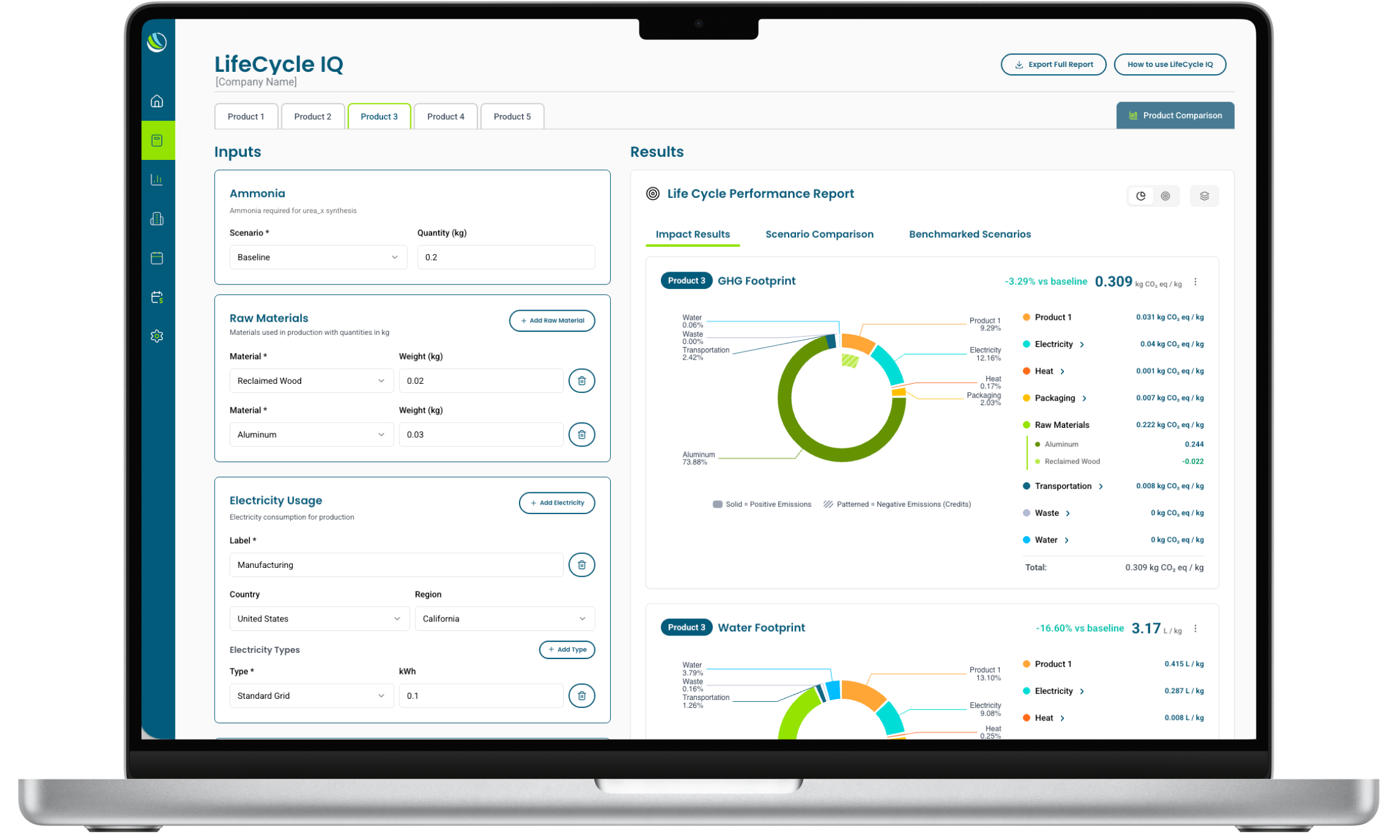
Most LCAs are built to satisfy a request, then sit in a folder. LifeCycle IQ is built to be used. It puts product-level LCA and cost analysis in one model, so you can swap a supplier, change a material, or shift volume and see what happens to footprint, cost, and risk before you commit. Every model, built on ISO 14040 and 14044 methodology, is reviewed by independent researchers, and is benchmarked against our database of more than 450 industries, so your results hold up when a customer, investor, or regulator asks how they were built. And because the model updates as your product changes, it's still right next quarter.
Book a meeting

LifeCycle IQ dashboard showing multi-product inputs, GHG and water footprint results, and benchmarked scenarios

About Boundless

An Industry Research and Impact Analytics Firm, Since 2013

Boundless is an industry research and environmental impact analytics firm that provides objective, actionable insights to accelerate investment toward clean technologies and companies driving positive environmental change. We employ a science-based, data-driven approach grounded in the proven methodologies of LCA and Techno-Economic Analysis.

Our approach emphasizes close collaboration with customers, so models and analyses stay representative of their specific systems, products, and operational realities. The scores and metrics we produce are robust and decision-relevant, supported by independent validation from external industry and scientific experts.